
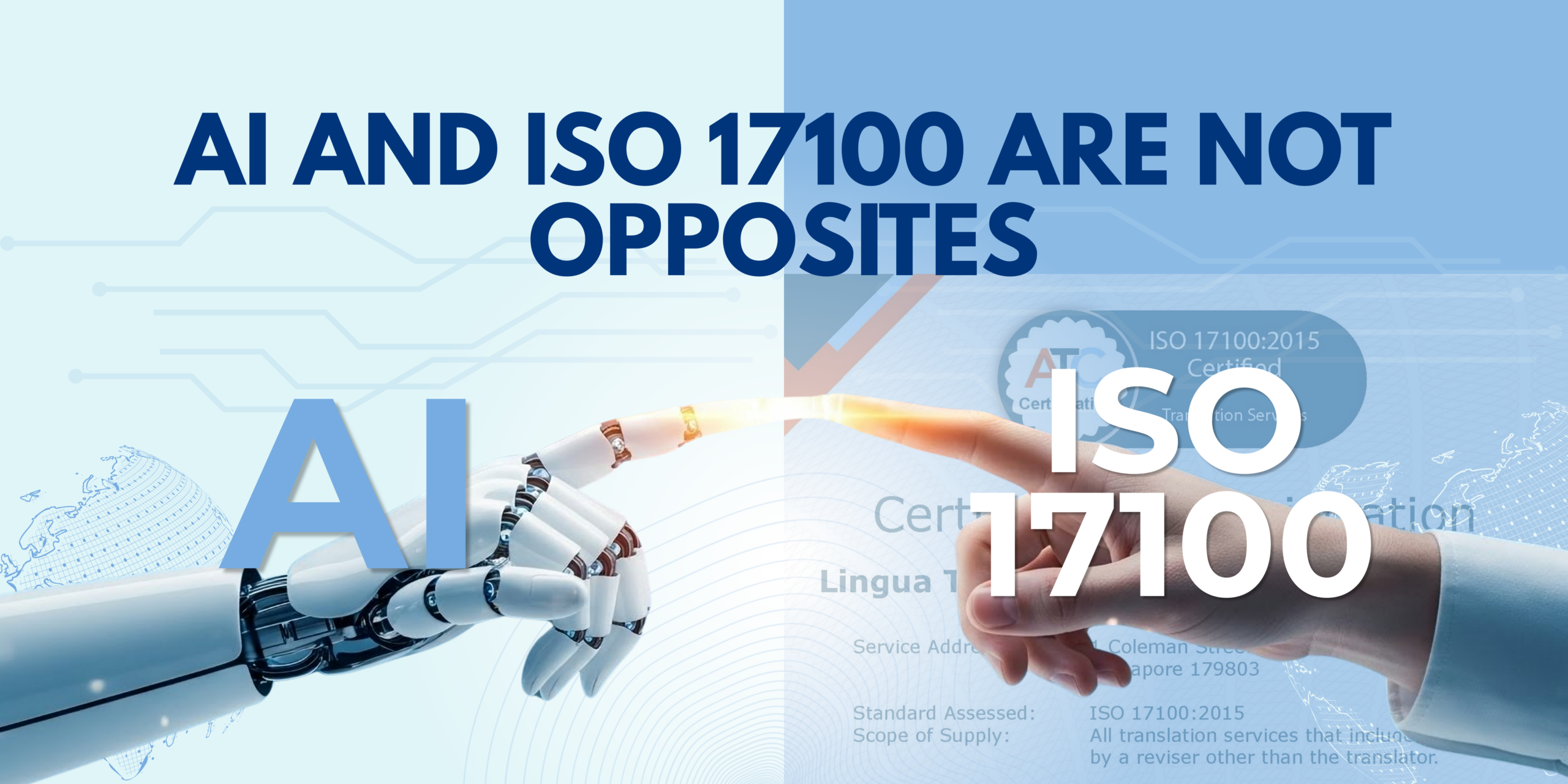
The translation industry is often pushed into a simple argument:
Human or AI.
Traditional or technological.
Old versus new.
We think that framing is too simple.
LTI uses technology extensively.
Our translation operations are managed through technology.
Our LexisAI services use AI.
Our workflows continue to evolve.
We also maintain an ISO 17100-certified human translation process.
Those positions are not contradictory.
The question is not whether technology should be used.
It should.
The better question is where technology belongs in the workflow and where professional human judgment is still required.
A certified translation process can still be technology-enabled
Our recent ISO 17100 surveillance audit did not assess a company resisting technology.
The auditor specifically noted LTI’s translation service delivery performed on our Odoo platform, and the audit also confirmed that appropriate industry-specific technology tools were available.
Technology is therefore not outside the professional process.
It is part of the infrastructure supporting it.
What AI changes
AI can accelerate first-draft production.
It can help process larger volumes.
It can support terminology and context management in controlled workflows.
It can create useful options for lower-risk content where full human translation may not be commercially necessary.
And when clients already have AI-generated translation, assessment can help determine whether that output is worth editing at all.
What AI does not automatically decide
AI does not determine how much risk a business should accept.
It does not know whether a document will be used internally, published publicly, relied on by a patient or submitted to a regulator unless the workflow is designed around that context.
It does not decide whether a professional should reject the output and start again.
Those are workflow and accountability decisions.
More technology should lead to better routing, not one universal workflow
This is the logic behind LTI’s current service framework.
Some content may be suitable for managed AI-only translation.
Some may benefit from AI-assisted translation with expert human revision and QA.
Existing AI output may require assessment first.
Some content should remain fully human-translated under a professional translation, revision, and QA workflow.
So we do not see AI adoption as an argument for abandoning ISO 17100.
If anything, the more translation production becomes automated, the more important it becomes to be clear about where professional control starts, where it ends and who is accountable for the outcome.
Technology can accelerate.
Automation can simplify.
AI can produce.
Humans can assess, revise, challenge and decide.
The important thing is knowing when each is appropriate.
LTI is not choosing between technology and people.
We are choosing where each belongs.
Human-led. AI-enhanced. Accountable to you.