
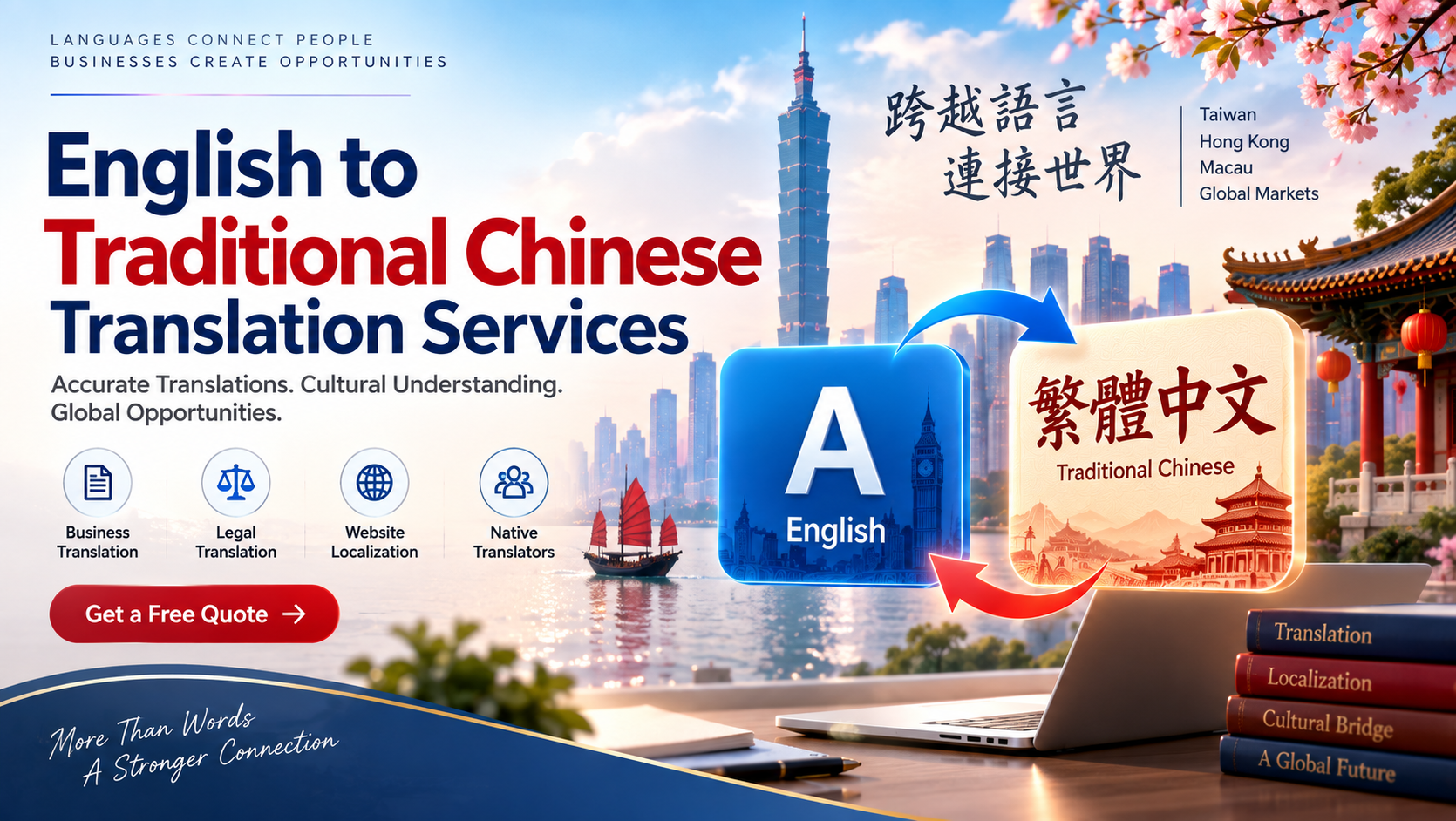
English to Traditional Chinese Translation
English remains one of the most widely used international business languages, while Traditional Chinese plays an important role in markets such as Taiwan, Hong Kong, and Macau. For organizations targeting these audiences, accurate English to Traditional Chinese translation is an important part of effective international communication.
Professional translation is more than replacing English words with Chinese characters. A high-quality English-to-Traditional-Chinese translation must preserve the original meaning while adapting terminology, tone, cultural references, formatting, and communication style to the intended audience. This becomes particularly important for legal documents, marketing campaigns, websites, financial information, technical documentation, healthcare content, and corporate communications.
For businesses in Singapore, professional Chinese translation can also support regional expansion. Although Simplified Chinese is commonly used in Singapore, businesses targeting Taiwan, Hong Kong, Macau, or specific Traditional Chinese-speaking audiences may require Traditional Chinese content and market-specific localization.
Lingua Technologies International Pte Ltd provides professional English-to-Chinese translation and localization services, including English to Traditional Chinese translation. The company has extensive experience supporting Chinese-language projects and has developed specialist linguistic resources for different industries and markets.
What Is English to Traditional Chinese Translation?
English to Traditional Chinese translation is the process of converting English written content into Traditional Chinese while preserving the meaning, intent, context, tone, and purpose of the original material.
Traditional Chinese uses the traditional character set, which differs from Simplified Chinese in many written forms. However, the distinction is not limited to characters. Different Traditional Chinese markets can also have differences in terminology, expressions, sentence structures, punctuation, cultural references, and preferred vocabulary.
For example, a company preparing content for Taiwan may require Traditional Chinese adapted for a Taiwanese audience, while content intended for Hong Kong may need terminology and expressions appropriate to Hong Kong users.
This means that simply converting Simplified Chinese characters into Traditional Chinese characters is not necessarily enough to create a professional translation.
A successful English-to-Traditional-Chinese project considers the target market from the beginning.
Why Do Businesses Need English to Traditional Chinese Translation?
Companies expanding into international markets need to communicate in the language their customers understand most naturally.
English content can be effective for international business communication, but customers may respond better when information is available in their preferred language.
English-to-Traditional-Chinese translation can help businesses:
Reach Traditional Chinese-speaking customers
Expand into Taiwan and Hong Kong markets
Support regional business partnerships
Localize websites and digital platforms
Translate legal and corporate documentation
Adapt marketing campaigns
Translate product information
Improve customer experience
Localize software and applications
Support international sales
Translate technical documentation
Communicate financial and business information
Professional translation can also strengthen brand credibility. Poorly translated content can create confusion, reduce trust, and make an otherwise professional organization appear less credible.
For companies investing in international expansion, language quality should therefore be treated as part of the overall customer experience.
Traditional Chinese vs Simplified Chinese
One of the most important decisions in a Chinese translation project is determining whether the target audience requires Simplified Chinese or Traditional Chinese.
Simplified Chinese is widely used in Mainland China and Singapore, while Traditional Chinese is commonly used in Taiwan, Hong Kong, and Macau. However, regional language differences mean that selecting the correct character set is only the first step.
Traditional Chinese uses more complex character forms than Simplified Chinese. For example, the traditional form of “國” is different from the simplified form “国.”
Although readers familiar with Chinese may understand both forms, businesses should generally use the writing system expected by their target audience.
A professional translation provider can also help determine whether a project requires market-specific localization beyond the character set.
English to Traditional Chinese for Taiwan
Taiwan is one of the most important markets for Traditional Chinese content.
Businesses targeting Taiwan may need Traditional Chinese translation for:
Corporate websites
Product descriptions
Marketing campaigns
Contracts
Business documents
Technical manuals
Software
Mobile applications
Financial documents
Educational materials
Healthcare information
E-commerce content
Advertising materials
Traditional Chinese used in Taiwan generally follows terminology and language conventions appropriate to Taiwanese Mandarin.
For example, a product name or technical term may require a different Chinese expression in Taiwan than the equivalent term used in Mainland China.
This is why professional localization is particularly important for companies entering the Taiwanese market.
English to Traditional Chinese for Hong Kong
Hong Kong is another major Traditional Chinese market.
However, Hong Kong has its own linguistic characteristics. Cantonese is widely spoken, while Traditional Chinese is commonly used in written communication.
Businesses targeting Hong Kong may therefore need Traditional Chinese localization that reflects local vocabulary and communication conventions.
Potential projects include:
Website localization
Financial documents
Banking materials
Real estate information
Tourism content
Retail content
Legal documents
Corporate communications
Product information
Advertising
Software interfaces
Mobile applications
A translation intended for Taiwan should not automatically be assumed to be ideal for Hong Kong.
The target market, audience, communication purpose, and industry should all be considered.
English to Traditional Chinese for Macau
Macau also uses Traditional Chinese in many written contexts.
Businesses working with Macau audiences may require Traditional Chinese translation for:
Tourism materials
Hotel information
Gaming-related corporate content
Retail information
Business documents
Legal materials
Marketing campaigns
Websites
Customer communications
As with Taiwan and Hong Kong, localization can help ensure that the translated content feels natural to the intended audience.
English to Traditional Chinese in Singapore
Singapore presents an interesting multilingual environment.
Simplified Chinese is widely used among Chinese-speaking audiences in Singapore, but businesses may still encounter situations where Traditional Chinese is required for specific customers, organizations, publications, regional campaigns, or international communication.
Companies operating in Singapore and targeting multiple Chinese-speaking markets may therefore need both Simplified and Traditional Chinese versions.
For example, an organization could require:
English to Simplified Chinese for Singapore
English to Simplified Chinese for Mainland China
English to Traditional Chinese for Taiwan
English to Traditional Chinese for Hong Kong
These versions should not always be treated as identical translations.
Lingua Technologies International Pte Ltd specifically highlights the importance of distinguishing between different Chinese markets and notes that localization may require separate versions for markets such as Singapore, Mainland China, Taiwan, Hong Kong, and Macau.
Why Literal English to Chinese Translation Can Be a Problem
One of the most common translation mistakes is translating English sentence by sentence without considering context.
English and Chinese have different grammatical structures, sentence patterns, expressions, and conventions.
A word can also have multiple meanings depending on its context.
For example, the English word “charge” can refer to a fee, responsibility, accusation, electrical energy, or an instruction to attack. Translating the word without understanding the sentence can result in an incorrect Chinese translation.
Professional translators therefore consider:
Context
Industry
Target audience
Sentence structure
Terminology
Tone
Cultural meaning
Communication purpose
A good English-to-Traditional-Chinese translation should communicate the intended message rather than simply reproduce individual English words.
English to Traditional Chinese Website Translation
A website is often the first point of contact between a business and its customers.
If a company wants to reach Traditional Chinese-speaking audiences, translating its website can make its services more accessible.
Website translation may include:
Homepage
About Us page
Service pages
Product pages
Landing pages
Blog articles
FAQs
Contact pages
Navigation menus
Forms
Terms and conditions
Privacy policies
Product information
Customer support content
Website localization can also involve adapting currencies, dates, measurements, terminology, images, user interface elements, and other market-specific details.
For businesses targeting Taiwan or Hong Kong, simply converting an English website into Traditional Chinese may not be sufficient. The content should be reviewed for regional language preferences and cultural relevance.
English to Traditional Chinese SEO Translation
International SEO requires more than translating website content.
Search behavior differs between languages and markets. A keyword that performs well in English may not have the same search intent or popularity when translated directly into Traditional Chinese.
Professional Chinese SEO localization can involve:
Keyword research
Search-intent analysis
Chinese page titles
Meta descriptions
H1 and H2 headings
Product keywords
Image alt text
URL considerations
Internal linking
Localized content
FAQ optimization
Search-friendly terminology
For example, a company selling software in Taiwan may need to research how Taiwanese users search for that particular software category rather than simply translating its English keywords.
SEO translation should therefore combine linguistic expertise with an understanding of the target market.
English to Traditional Chinese Marketing Translation
Marketing content presents another major challenge.
A slogan that sounds persuasive in English may sound unnatural or ineffective when translated literally.
Marketing translation may require transcreation, where the translator adapts the message while preserving the intended emotional impact.
English-to-Traditional-Chinese marketing services can include:
Advertisements
Social media content
Brochures
Flyers
Product campaigns
Email marketing
Sales presentations
Brand messaging
Video scripts
Digital advertisements
Website campaigns
Promotional content
The objective is to make the Chinese content sound like professionally created marketing material rather than a translated version of English copy.
English to Traditional Chinese Business Translation
International businesses often need to translate corporate information into Traditional Chinese.
Business translation can include:
Company profiles
Business proposals
Reports
Presentations
Contracts
Partnership agreements
Policies
Training documents
Corporate announcements
Internal communications
Emails
Sales materials
Business plans
Professional business translation should maintain the original intent while using terminology appropriate to the target market.
Tone is also important. A formal corporate document should not suddenly become overly casual after translation.
English to Traditional Chinese Legal Translation
Legal translation requires exceptional attention to terminology and context.
Legal documents can contain precise wording where a small change may affect interpretation.
English-to-Traditional-Chinese legal translation may involve:
Contracts
Agreements
Terms and conditions
Corporate documents
Compliance documents
Intellectual property materials
Legal notices
Employment agreements
Regulatory information
Court-related documentation
Privacy policies
Terms of service
A professional legal translator needs to understand both the source language and the legal terminology relevant to the target market.
Businesses should also determine whether a document needs certification, notarization, authentication, or another formal process before commissioning the translation.
English to Traditional Chinese Certified Translation
Some documents require certified translation for official or administrative purposes.
Depending on the organization receiving the document, certified translation may be required for:
Academic certificates
Diplomas
Transcripts
Birth certificates
Marriage certificates
Identity documents
Passports
Legal documents
Corporate documents
Government records
Immigration-related documents
Certification requirements can vary depending on the receiving authority and purpose of the translation.
Businesses and individuals should therefore confirm the exact requirements before beginning a certified translation project.
Lingua Technologies International Pte Ltd provides certified translation solutions as part of its wider language services. Its website also highlights ISO 17100 certification and professional translation processes.
English to Traditional Chinese Medical Translation
Medical translation requires specialist knowledge because incorrect terminology can create serious communication problems.
Medical and healthcare translation may include:
Medical reports
Patient records
Clinical trial documentation
Medical device manuals
Pharmaceutical information
Prescriptions
Healthcare websites
Patient information
Insurance documents
Medical research
Healthcare marketing
Medical translation should be performed by linguists who understand the relevant terminology and communication requirements.
The translator must also maintain consistency across repeated medical terms and ensure that the final content remains clear for its intended audience.
English to Traditional Chinese Technical Translation
Technical documentation often contains specialized terminology and detailed instructions.
Technical translation may include:
User manuals
Installation guides
Engineering documentation
Product specifications
Safety instructions
Technical reports
Maintenance manuals
Software documentation
Equipment manuals
Manufacturing documents
The translation must be technically accurate as well as linguistically natural.
Inconsistent terminology can make a technical manual difficult to understand and may potentially lead to incorrect use of a product or system.
For large technical projects, terminology databases and translation memory can help maintain consistency.
English to Traditional Chinese Financial Translation
Financial translation requires careful handling of specialized terminology and numerical information.
Documents may include:
Annual reports
Financial statements
Banking documents
Investment reports
Insurance materials
Corporate finance information
Investor presentations
Economic research
Accounting documentation
Financial marketing materials
Accuracy is particularly important when translating numbers, financial terms, dates, currencies, percentages, and legal statements.
Professional review can help reduce the risk of errors.
English to Traditional Chinese E-Commerce Translation
E-commerce businesses increasingly serve international customers.
A company selling products to Traditional Chinese-speaking consumers may need to translate:
Product descriptions
Product specifications
Category pages
Shopping guides
Checkout information
Shipping policies
Returns policies
Payment information
Promotional content
Customer service pages
Mobile applications
Product reviews
However, e-commerce translation should also focus on customer behavior.
Product descriptions need to be persuasive, understandable, and culturally appropriate.
A literal translation can make product pages sound unnatural, while localized content can create a smoother customer experience.
English to Traditional Chinese Software Localization
Software companies targeting Traditional Chinese-speaking markets may need to localize their products.
Software localization can include:
User interfaces
Buttons
Menus
Notifications
Error messages
Help content
Settings
Mobile applications
Software documentation
Online support content
Localization also requires attention to character length.
Chinese text can occupy different amounts of screen space compared with English. Therefore, translated interface elements may need to be tested to ensure that buttons, menus, and other elements remain usable.
English to Traditional Chinese Document Translation
Businesses often have documents that need to be translated while retaining the original formatting.
These may include:
PDF documents
Word documents
PowerPoint presentations
Excel files
Scanned documents
Brochures
Catalogues
Reports
Manuals
Certificates
Translation is only one part of the project. Formatting may also need to be recreated so that the final Chinese document looks professional.
Desktop publishing and multilingual formatting can be especially important for brochures, presentations, catalogues, and marketing materials.
English to Traditional Chinese Localization
Localization takes translation one step further.
Translation focuses on language, while localization considers how the content should function within a specific market.
Localization can address:
Language conventions
Cultural references
Currency
Dates
Measurements
Names
Images
Colors
Formatting
User expectations
Product terminology
Marketing messages
Search behavior
For example, a Traditional Chinese website targeting Taiwan may require different terminology from a Traditional Chinese website targeting Hong Kong.
This is why businesses should define their target audience before beginning a translation project.
Human Translation vs Machine Translation
Machine translation has become increasingly accessible, but professional human translation remains important for content where accuracy, tone, context, and cultural relevance matter.
Automated translation can be useful for certain internal workflows or preliminary understanding. However, it may struggle with:
Idioms
Brand messaging
Legal terminology
Technical language
Cultural references
Ambiguous words
Marketing language
Context-dependent expressions
Professional human translators can interpret the broader context and make decisions based on the purpose of the content.
Lingua Technologies International emphasizes the human aspect of translation while combining linguistic expertise with structured processes and technology. Its approach describes translation as both an art and a science.
Translation Memory for Traditional Chinese Projects
Large organizations may translate similar content repeatedly.
Translation Memory Management can help store previously approved translations so that appropriate segments can be reused.
This can improve:
Consistency
Efficiency
Terminology management
Project turnaround
Brand-language consistency
Long-term translation workflows
For organizations that regularly update product manuals, websites, software, or corporate documents, translation memory can be particularly valuable.
The English to Traditional Chinese Translation Process
A professional translation project generally involves several stages.
1. Project Assessment
The translation provider reviews the source material and determines:
Word count
Document type
Subject matter
Target market
Chinese variant
Deadline
Formatting requirements
Certification requirements
Special terminology
2. Translator Selection
The project is assigned to an appropriate linguist based on language expertise, industry knowledge, and target-market requirements.
3. Translation
The English content is translated into Traditional Chinese while preserving meaning, terminology, tone, and intent.
4. Editing and Review
The translated document is reviewed for:
Accuracy
Grammar
Terminology
Consistency
Readability
Tone
Meaning
5. Quality Assurance
Quality checks identify potential omissions, formatting problems, terminology inconsistencies, and other issues.
6. Final Delivery
The completed Traditional Chinese translation is delivered in the required format.
Additional localization, desktop publishing, proofreading, or certification services can be included when required.
How to Choose an English to Traditional Chinese Translation Company
Choosing a professional translation provider is an important decision.
Check Chinese Translation Experience
Look for a provider with established experience in English-to-Chinese translation.
Confirm Traditional Chinese Expertise
Make sure the provider can support the specific market you are targeting.
Taiwan, Hong Kong, and Macau may require different localization approaches.
Check Industry Expertise
If your content is legal, medical, financial, technical, or highly specialized, select a provider with relevant experience.
Ask About Quality Assurance
A professional translation company should have structured review and quality-control procedures.
Consider ISO 17100
ISO 17100 is an international standard specifically addressing requirements for translation services. Lingua Technologies International states that it achieved ISO 17100 certification in 2016 and uses the standard as part of its translation-service approach.
Review Localization Capabilities
If you are entering a new market, translation alone may not be enough. Look for a provider capable of localization.
Consider Confidentiality
Business and legal documents can contain sensitive information. Ensure that the translation provider has appropriate procedures for protecting client information.
Why Choose Lingua Technologies International Pte Ltd?
Lingua Technologies International Pte Ltd is a Singapore-based translation company established in 1996. Its stated founding mission is to help organizations communicate with global customers through localized multilingual content and centralized language-management processes.
The company provides English-to-Chinese and Chinese-to-English translation services, including Simplified and Traditional Chinese.
Lingua states that it has more than two decades of experience providing English-to-Simplified Chinese, English-to-Traditional Chinese, and Chinese-to-English translation services. It also states that it has translated more than one billion words into Chinese since 1996 and that more than 70% of its translation business is for the Chinese market.
Its broader services include:
Translation and localization
Certified translation
Editing and proofreading
Translation Memory Management
Interpreting
Desktop publishing
Transcription
Subtitling
Live captioning
The company also states that its translation and localization archives cover more than 100 languages, including Simplified and Traditional Chinese.
This broad service capability can be useful for organizations that need multiple language solutions rather than a one-time document translation.
Common Mistakes to Avoid in English to Traditional Chinese Translation
Choosing the Wrong Chinese Variant
Using Simplified Chinese when the audience expects Traditional Chinese can create an unprofessional impression.
Treating Taiwan and Hong Kong as Identical
Both use Traditional Chinese, but their terminology and linguistic conventions can differ.
Translating Word for Word
Literal translation can produce unnatural or confusing sentences.
Ignoring Cultural Context
A phrase that works in English may not have the same effect in Chinese.
Using Unreviewed Machine Translation
Important business content should receive appropriate human review.
Ignoring SEO
A translated website still requires keyword and search-intent research for the target market.
Failing to Maintain Terminology
Different translations of the same product or technical term can create confusion.
Forgetting Formatting
Chinese translation can affect document layout, website interfaces, brochures, and software screens.
How Much Does English to Traditional Chinese Translation Cost?
The cost of English-to-Traditional-Chinese translation depends on several factors.
These can include:
Word count
Document complexity
Subject matter
Language requirements
Target market
Formatting
Certification
Deadline
Editing requirements
Localization requirements
Specialist terminology
A simple business document will generally require a different level of effort from a complex technical manual or legal contract.
For an accurate quotation, businesses should provide the source material and explain the intended target market, deadline, document format, and any certification or localization requirements.
FAQ About English to Traditional Chinese Translation
What is English to Traditional Chinese translation?
English-to-Traditional-Chinese translation converts English content into Traditional Chinese while preserving the original meaning, purpose, tone, and context.
Which countries and regions use Traditional Chinese?
Traditional Chinese is commonly used in Taiwan, Hong Kong, and Macau. However, specific language conventions can differ between these markets.
Is Traditional Chinese the same in Taiwan and Hong Kong?
No. Although both markets use Traditional Chinese characters, vocabulary, expressions, terminology, and spoken-language influences can differ.
Can I use the same Traditional Chinese translation for Taiwan and Hong Kong?
Sometimes the core translation may be reusable, but professional localization may be necessary to adapt terminology and expressions to each market.
Is Traditional Chinese used in Singapore?
Singapore primarily uses Simplified Chinese, but Traditional Chinese may be required for specific audiences, projects, or regional communication requirements.
Can you translate English websites into Traditional Chinese?
Yes. Website translation can cover visible content, navigation, product pages, blogs, FAQs, metadata, and other digital content.
Is English-to-Traditional-Chinese translation suitable for marketing?
Yes. Marketing translation can be combined with localization or transcreation to ensure that campaigns sound natural and persuasive to the target audience.
Can legal documents be translated into Traditional Chinese?
Yes. Legal translation requires specialist terminology and careful review. Certification or other formal requirements may apply depending on the intended use.
Can medical documents be translated into Traditional Chinese?
Yes. Medical translation can cover healthcare documents, medical reports, clinical materials, pharmaceutical content, medical device documentation, and patient information.
Does Lingua Technologies International Pte Ltd provide Traditional Chinese translation?
Yes. Lingua Technologies International Pte Ltd provides English-to-Traditional-Chinese and other Chinese translation services for different industries and markets.
Conclusion
Professional English to Traditional Chinese translation is an essential service for organizations that want to communicate effectively with Traditional Chinese-speaking audiences.
Successful translation requires much more than converting English words into Chinese characters. Businesses need to consider the target market, writing system, terminology, cultural context, industry requirements, tone, formatting, and localization strategy.
Whether you need a Traditional Chinese website, marketing campaign, legal document, technical manual, financial report, medical document, software interface, academic document, or corporate communication, working with experienced language professionals can help ensure that your message remains accurate and effective.
For organizations based in Singapore and businesses expanding into Taiwan, Hong Kong, Macau, and other Chinese-speaking markets, Lingua Technologies International Pte Ltd offers English-to-Traditional-Chinese translation, localization, certified translation, editing, proofreading, and other multilingual language solutions.
With its long-standing experience in Chinese translation, ISO 17100 certification, professional linguistic resources, and market-focused approach, Lingua Technologies International Pte Ltd can support organizations that need reliable English-to-Traditional-Chinese communication.